What Digital Archiving Means and How It Differs From Storage
Storing a file on a hard drive and its preservation for decades do not amount to the same thing, though they may seem identical from the outside. Everyday storage and backup systems are geared to keep data available now and for recoverability in the event of a crash or accidental deletion. Archiving operations of course operate on a totally different temporality, demanding different priorities.
The governance aspect of archiving demands just as much attention as anything about technology. Knowledge of the existence of a 2003 TIFF image occupies only half the narrative; what it is of and who the creator is, and why it was created is the other half of the story that makes it a useful historical document. Storage makes data available for further life. Archiving gives data meaningfulness.
Why Long-Term Preservation Is Difficult but Essential

Time is not kind to digital files. Formats that were standard in the 1990s – think early WordPerfect documents or floppy disk data – are now largely unreadable without specialist software. This is format obsolescence, and it remains one of the most persistent threats in digital preservation. Hardware degrades too. Magnetic tapes lose integrity, optical discs develop disc rot, and storage servers fail without warning.
Cyber threats add another layer of risk. Ransomware attacks on public institutions have destroyed or encrypted irreplaceable records, and accidental deletion remains a surprisingly common cause of data loss. Poor metadata compounds every problem – without accurate descriptions of what a file is, who created it, and when, even a perfectly intact document can become effectively useless.
Organisations address these risks through a combination of methods. Integrity checks using checksums verify that files have not been altered or corrupted over time. Redundant storage across multiple locations reduces the chance of total loss. Regular migration to current formats keeps content accessible as technology changes. Documented preservation workflows ensure that processes are repeatable and auditable.
Digital Archives Must Evolve to Keep Knowledge Alive
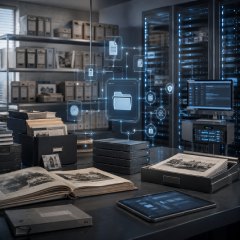
One of the most stubborn misconceptions that organizations hold is what happens when organizations treat an archive as a tidy, finished product. Preservation is a living endeavor, not something to be accomplished one-time. To link the importance of maintenance, however, it might be useful to distinguish between storage and archiving: storage keeps documents perpetually available for use, while archiving ensures storage well beyond the next decades, with maintenance of readability, authenticity, and usability.
The maintenance of data integrity over spans of time necessitates regular interventions in one way or another- format migrations and checksum verification, but institutions may also face downtime of one form or another that questions metadata retainment. Institutions equipped with actual archiving systems are not only preserving the records but are also acting as trustworthy sources in the development of sound historical perspective. Preservation strategies, in corresponding fashion, ought to adapt where file formats age and storage media are decaying. Future-proofed organizations are those that view their archives as functioning systems rather than static repositories that stand to gather inevitable risks without maintenance.