What Metadata Is and Why It Matters
Metadata provides a kind of common vocabulary that enables people and computers to read digital content in the same way, regardless of their origin. Without metadata, all digital content, be it an office contract turned into a scanned text or a photo-shopped product image, exists in isolation forever. Metadata, however, allows for the linking of multiple descriptive pieces of structured information to the actual digital asset, changing it forever.
Indeed, a digital photograph is imbued with metadata such as the title of the photo, the name of the photographer, the date of image capture, the format of the image file, and/or any intellectual-property rights or copyright-related concerns. Such structured information, in a way, metamorphoses the crude image file into something that could be identified, searched, and audited.
This is the sort of tagging that renders manageable such information scattered among numerous online libraries, document management systems, and repository systems for business contents. Such information, without proper tags, would make retrieval a mere guesswork; compliance reporting would barely be possible, and neither would the long-term preservation. Bringing huge masses of digital content in existence-the kind that an organisation can no longer manage without consistently identifying.
The Main Types of Metadata in Digital Systems
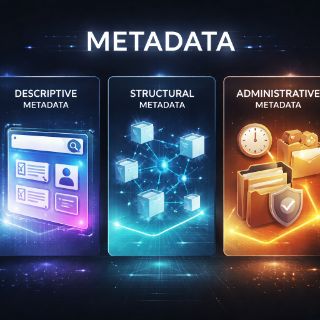
Three distinct categories do most of the heavy lifting when it comes to organising digital information: descriptive, structural, and administrative metadata.
Descriptive metadata is what helps users find things. Titles, keywords, subject headings, abstracts, and creator names all fall here. A digitised photograph in a national archive might carry descriptive metadata noting the location, date, and photographer – making it discoverable through a search that would otherwise return nothing.
Structural metadata explains how the parts of a resource fit together. In a digitised manuscript, it records page order and sequence. In an enterprise content management system, it maps the relationships between linked case files or document versions.
Administrative metadata covers the operational side: who owns a file, what rights apply, when it was created, how long it must be retained, and what technical format it uses. Healthcare systems rely on this layer heavily for access controls and regulatory compliance.
None of these categories operates in isolation. A digital asset management platform handling broadcast footage might use all three simultaneously – descriptive tags for search, structural data linking raw footage to edited cuts, and administrative records tracking licensing expiry dates.
How Metadata Standards Improve Search, Interoperability, and Preservation
Agreed rules for recording metadata consistently are what separate functional digital archives from chaotic ones. A schema defines which fields must be captured and in what format. A controlled vocabulary ensures that "United Kingdom," "UK," and "Britain" don't fragment search results across three separate buckets. Without these structures, teams working across different platforms will describe the same asset in incompatible ways, making reliable retrieval nearly impossible.
Interoperability is the ability of different systems to exchange and actually use information without manual rekeying or translation errors. Crosswalks make this practical by mapping equivalent fields between two schemas, say Dublin Core and MODS, so records can move between systems without losing meaning.
Data governance ties these standards together institutionally, setting policies for who maintains vocabularies, when schemas are updated, and how changes are documented. That change history matters for preservation. As systems evolve, the context, rights data, and format information embedded in metadata ensure records remain interpretable years or decades later.
Strong Metadata Standards Make Digital Information Usable
Each of the descriptive metadata, structural metadata, and administrative metadata forms an essential part that stands behind making that digital information retrievable, ordered and shareable, and preserves time. The saves themselves are likely to become outdated over time if there is no agony of discussion over the standardisation of any of the three. The standardisation allows records retrieval, the sharing of those records across some computer systems, and the trustworthiness of the stored data amid cycles of technological changes through years or even decades. For data and IT leaders, the early metadata will be the key ingredient of information strategy, rather than just a subsidiary issue left for the distant plan-ahead. It pays immediate dividends to be well integrated, kept in line with executive risk management, allow holdings to retain their best value. Organizations who determine this fact not only preserve data better but also use it to enhance their business strategy.